

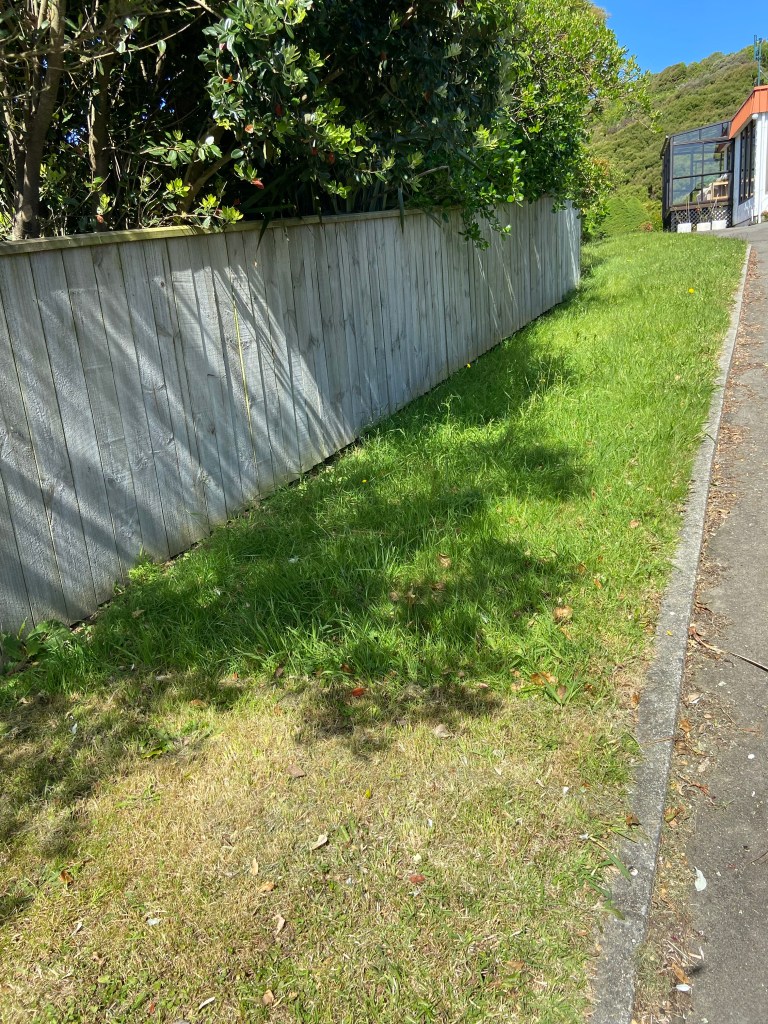
I’d gingerly put out some feelers on the Whitby Community Facebook and Neighbourly pages seeking thoughts about day to day urban experiences and connections with insect pollinators. Luke was among those who responded. I was thrilled when he invited me to pop round and chat about his gardening style. He had a plan to convert a grass strip alongside the driveway into wildflowers for bees, butterflies and other more-than-human neighbours. Yet on that warm afternoon there was something more I witnessed in the encounter.
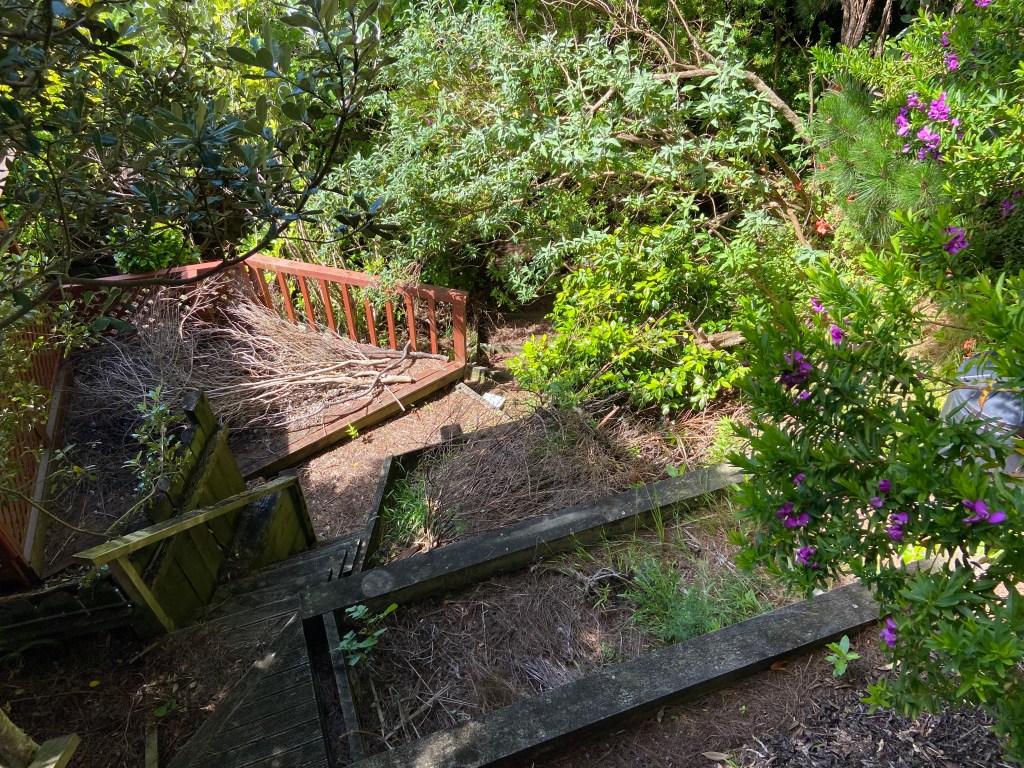
Luke’s place nestles against one of the neighbourhood hills, encircled by bush bent by prevailing winds. Beyond the tops of kanuka thickets and nikau fronds are spectacular views over Pāuatahanui Inlet. I follow Luke around the back of the house and witness a garden lush with flowers welcoming pollinator insects and birds. He has a natural way of being with plants, pausing here and there to inspect a flower or gently till the soil around a plant while patiently answering my questions about his approach. “With insects fresh in mind we don’t need pesticides. I like it when plants just survive” he says.
What prompted his idea to plant out a grass strip with wildflowers for the insect pollinators? He regularly mowed a grass strip along the driveway he says, but all the while kept wondering why he continued doing it. Luke had heard about the ‘No Mow’ campaign locally and overseas and decided to give it a go, not just for the pollinators but to save time on mowing too.
“We don’t have a lot of time for gardening” he says, so he’s letting things take over naturally. “Whatever survives I let it grow and I see more bees every year.” He leans over a patch of wild self-seeded strawberries and plucks a tiny red berry. “It’s also nice to forage and to come across stuff just growing.” Luke took over the place two years ago and since then most of the ornamental plants have gone. They required too much water and were needy in fertiliser. He moved plants to where they seemed “happiest.” I spot a startling white and pink striped iris which is attracting bumblebees. Luke deftly digs me out some bulbs so I can grow them in my garden. Lizards have been bequeathed a part of the garden too, under a pile of old branches and leaf litter.
“It’s been trial and error here,” he adds. The only money he has spent on the garden is $40 Japanese gardening tool used for everything.
Further round there is another discovery by the washing line. Above a wooden retaining wall, a dry clay bank is overhung with ground creepers. Luke remarks that there are often masses of bees here. We look closely at a couple of small black things that have settled on tiny daisies. One is a fly of sorts – flies are also pollinators! – but the other I think might be a native bee or a mason wasp. I was so excited to spot native bees feeding on manuka flowers on a walk up to the Spinnaker Lookout in late November. They don’t look anything like honeybees and love to drill into the clay banks to make simple nests. They also popped up in Marie and Alan’s garden. * I’ve added a link below to a great blog about our native bees.
I ask Luke what relationships he thinks are possible between humans and insect pollinators in suburban places. It’s about “appreciating the beauty of nature” which would happen if we paid more attention to it, he responds. Then comes back with another question. “Why are you mowing? Mowing a lawn is quite a time-consuming exercise. it’s a cost to the environment, and it costs less not to do it. Being in tune with nature is cheaper.” Luke is moving on for a few years to work overseas, so the plan for the wildflower strip might have to wait a bit longer. Or perhaps the new tenants will have a go. I’m also inspired to do something on my street berm!
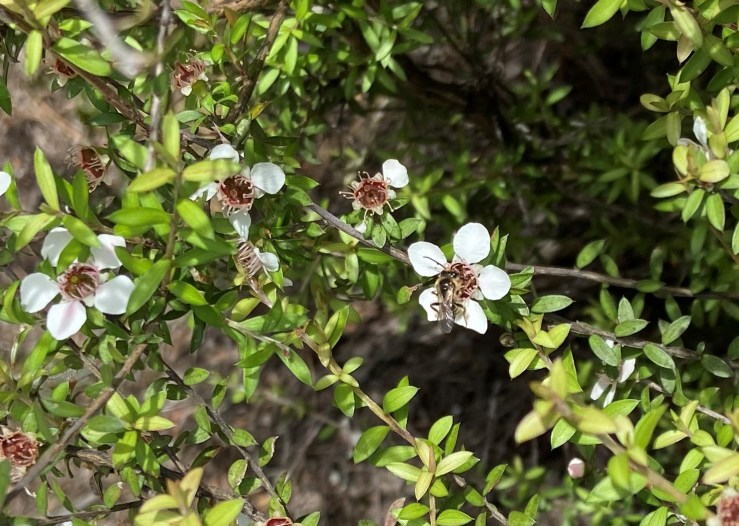
* Great blog about NZ’s native bees by Julia Kasper of Te Papa
 Edge of Things
This is so inspiring!
LikeLiked by 1 person