Welcome to Edge of Things

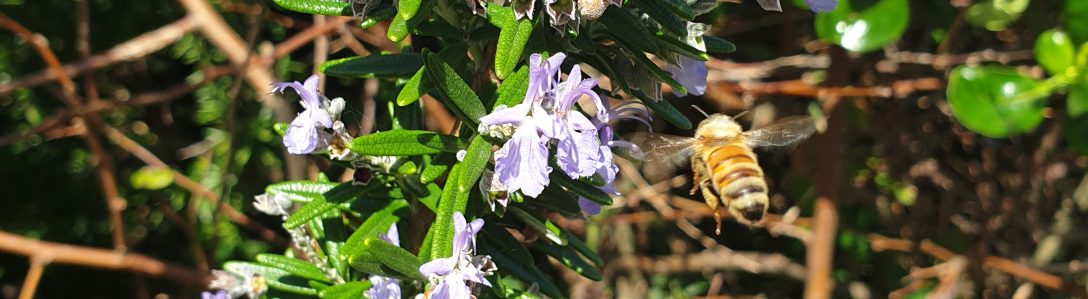
Welcome to this experimental journey where I’m attempting to pay closer attention to everyday encounters with pollinator insects like bees, butterflies, and moths in the places we live. Insects are declining drastically across the planet, yet they are vital to all life. I’m curious about who survives in my neighbourhood, how we relate with them, or they with us. So, I’ve committed to a walking routine along various street verges, tracks, unused plots, and small parks in the Porirua suburb of Whitby, plus my own tiny backyard, to journal, photograph and video day-to-day moments with these more=than-human beings. I’m also seeking to connect with my neighbours, locals, and others to gather and share stories of encounters with the insects.

Why am I doing this?

I’m a journalist, communicator and artist and this blog is part of a research project with Victoria University of Wellington. Like so many others during our COVID lockdowns, I noticed that when the human buzz subsided, we had space to notice little things in backyards and on local walks. We heard uncommon trills, chimes, and warbles across valleys and city streets. Bees hummed around wildflowers popping up in less manicured and neglected verges. When humans retreated, it seemed there was an opening for other beings to re-flourish. I’m hoping to creatively explore these relationships further, particularly with insects who often go unnoticed. 

Continue reading “Welcome to Edge of Things”
Champion for the Unloved

How to figure my way into 2024 in world that seems ever more uninhabitable? 2023 was the hottest year ever. Headlines scream this year will be worse. Devastating floods and fires are likely to repeat. Wars rage unchecked. At the same time my mailbox reminds me of work deadlines. I’m paralyzed by the discord of this – “there is a lonely absurdity in the idea of racing against the clock at the end of time” writes Jenny Odell in Saving Time: Discovering a life beyond the clock.

Continue reading “Champion for the Unloved”

Contemplating eco berms, challenging norms?

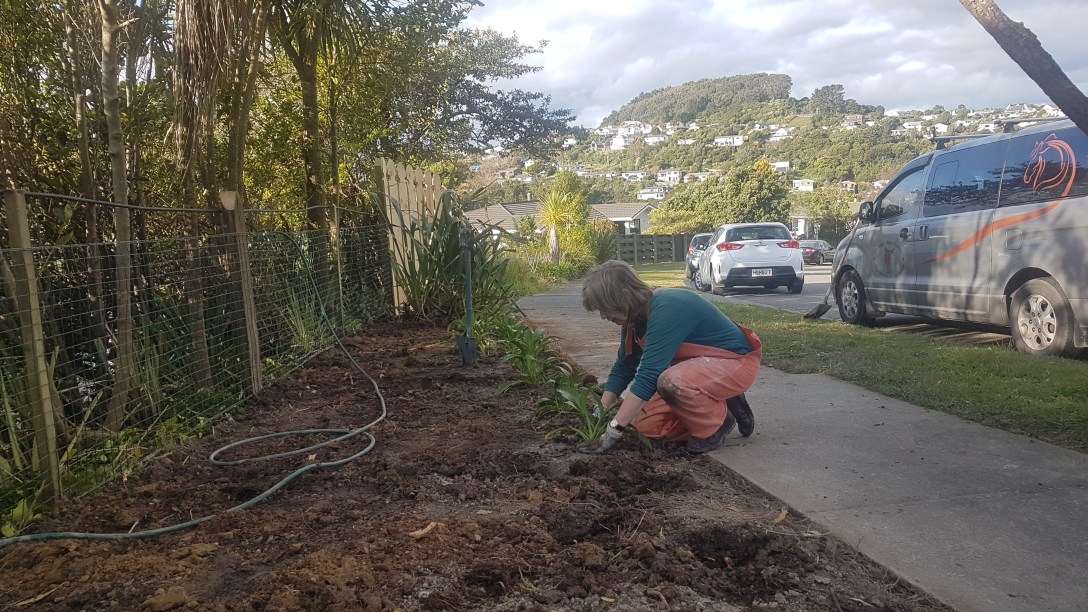
When I first started this journey, I began trialing the ‘No Mow‘ approach, leaving a portion of our small lawn un-mowed. Just to see what happened. What I witnessed was eye opening, challenging our suburban norms of why we have so many grass lawns and berms. It drew me to another form of action – planting an eco berm pathway which could connect our insect pollinators to fragments of bush, and at the same time maybe connect people who live here.

Continue reading “Contemplating eco berms, challenging norms?”

Last dance

She is tattered, at the end of her short life. Her body shakes and shivers. I tiptoe closer but she’s too preoccupied to bother with me. Slowly she clasps a bunch of leaves with thin black legs and draws her abdomen up into a sickle shape, with the tip pressing under a leaf depositing a tiny pale-yellow egg. She repeats this process several times resting in between, vibrating. It’s a big effort and I marvel at her energy and determination. At her peak she may have been laying between 300-400 eggs at a rate of 40 eggs a day! Now on her last legs she is perhaps the last of the female monarchs that will visit our swan plant/milkweed. There is a slim chance her offspring might slowly pupate through winter and emerge as new adults in spring. And there are other reminders that this is a time, a season, of dying and release.

Continue reading “Last dance”

Monarch dance

Earlier this year I watched as one of the first monarch butterflies circled the milkweed/swan plant below our deck. This time I grabbed a pencil and traced her flow on paper, intrigued at her mysterious path of many careful circuits. The drawing ends up a puzzling maze, as if meant to confuse. My notes read she spends minutes circling and making approaches to the plant, swooping past pumpkins, the mustard seed, the raspberries, the snowball tree, diverting attention? Perhaps checking it’s safe, scenting? It’s a dizzying energetic dance, never still. I trace the lines over and over trying to follow the complicated passage.

Continue reading “Monarch dance”

Mothing

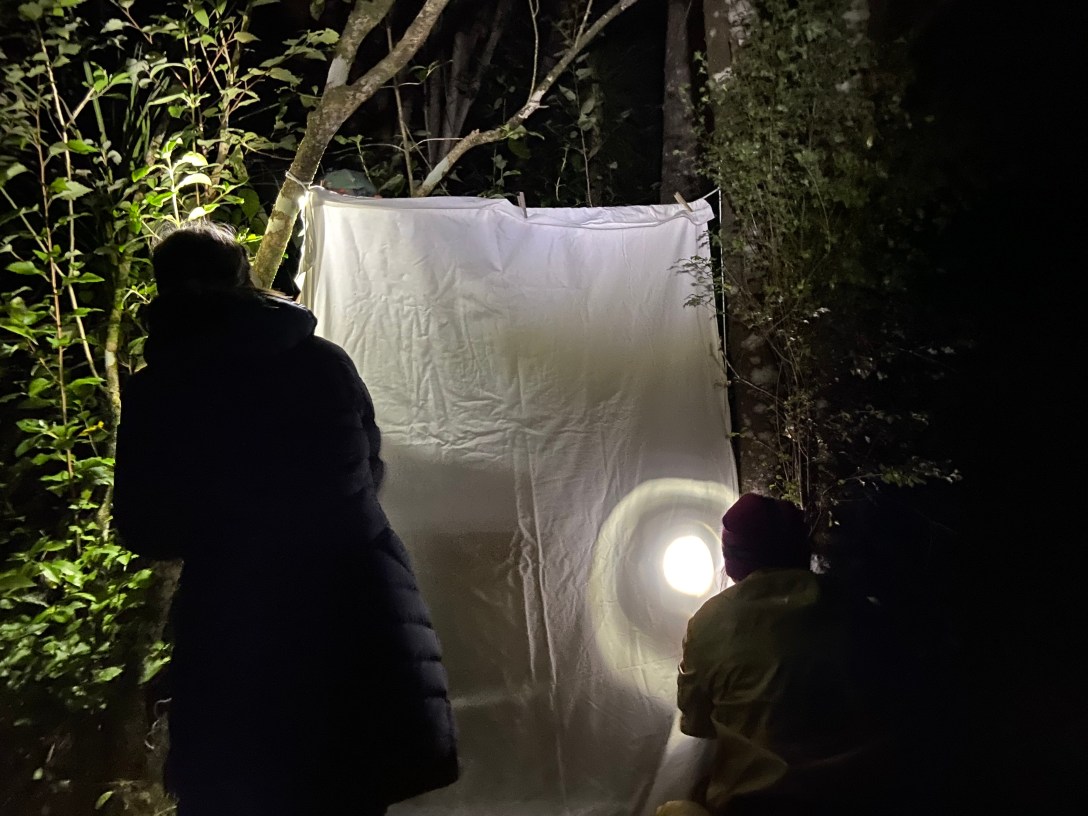
If you see torches flashing in the bush this Saturday night, you’ll know it’s just us!”  I’d emailed nearby neighbours to let them know a small group of us were going down the Carvel Walkway to discover what nocturnal moth neighbours we might have, attracting them to us with a home-made light trap.

Darkness descended around 8.30pm, our cue to head down to a spot in the bush, just beyond streetlights and glows from home windows. And if anyone was looking from those windows as we walked past they may well have fallen about laughing. Fey had jokingly made us bibs titled moth count supervisor and moth count interns to wear over our rain jackets and over-trousers. And combined with flashing headlights strapped to beanies our rather bizarre looking convoy marched down the road. I really wasn’t sure how this experiment would go.

Continue reading “Mothing”

Seeds, winds, circlings

Autumn equinoctial winds whip through neighbourhood lanes. It’s a circling back to this time last year when I began consciously noticing and photographing what’s happening with insect pollinators and other more-than-humans living here.

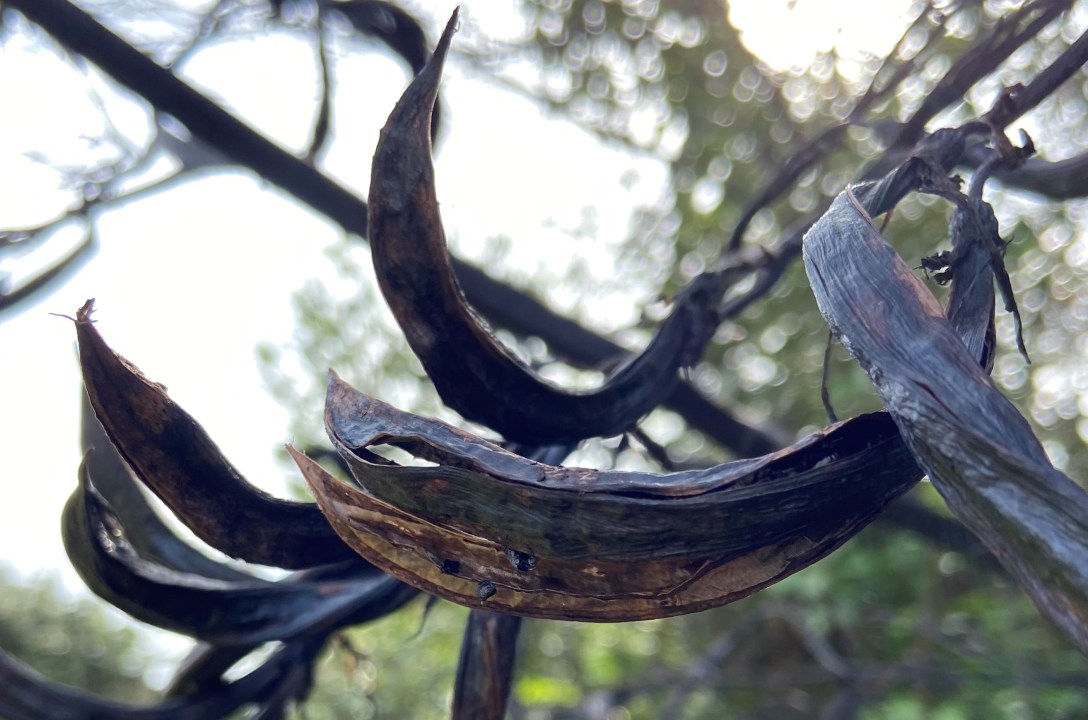
Hopping chaffinches laboriously harvest the oily black seeds spinning out of cracked flax pods. And the wax eyes have arrived back in the hebes, picking at a potpouri of seed heads. Swollen fruit and berries – from flowers fertilised earlier by pollinators – begin to release and die. A profusion of their seeds scatter out. Capsules of future life. The valley reminds me of the repeating pulses, patterns and cycles. Old friends again.

Continue reading “Seeds, winds, circlings”

Luke’s way of thinking

I’d gingerly put out some feelers on the Whitby Community Facebook and Neighbourly pages seeking thoughts about day to day urban experiences and connections with insect pollinators. Luke was among those who responded. I was thrilled when he invited me to pop round and chat about his gardening style. He had a plan to convert a grass strip alongside the driveway into wildflowers for bees, butterflies and other more-than-human neighbours. Yet on that warm afternoon there was something more I witnessed in the encounter.

Continue reading “Luke’s way of thinking”

Out of whack

I feel out of whack. Contemplating powerlessness and unpredictability in the wake of the recent climate floods. The bubble of societal comfort burst overnight. Does awful natural force ironically provide sight lines to sensing imbalance?

On a vastly different scale other things tug in the same direction. The other day we visited Mike our local beekeeper at his honey stand in Brown’s Bay. There’s less manuka honey than normal for this time. The manuka flowering season was shorter this year, even the kanuka was over in a few days due to the wet and wind. That explains why I never saw the usual white dusting, like icing, across the valley. And there’s less honeycomb too – the bees have been eating more of it to sustain themselves over the damp summer.

Female monarch butterflies have only just started to visit my swan plants in earnest in the past two weeks to lay small pale yellow eggs. It seems late. They are also sensitive to temperature. Last year was a disaster. Hundreds of caterpillars stripped my few small plants within days, then humped off starving, in the hopes of finding food elsewhere, or to die. This year I got a head start, planted early (late winter) and now have lush full-grown plants. But not many caterpillars. Most live for a day or so then disappear before they mature. They are probably being taken by the many wasps around that hunt for protein to feed their queens.

Impotence has crept into my haphazard attempts to support the local butterfly population.

After the cyclone

When the tail end of Cyclone Gabrielle spun away from us in Pauatahanui things became eerily still. I had an intense urge to climb up somewhere, perhaps to try and make sense of the climate tragedy that just happened further north. At the top of Kahu Road the rain and wind departed and the sky started to clear. The only sound was the intense ringing of cicadas, as if shouting out the shock that vibrated through our collective psyche.  

Continue reading “After the cyclone”

First fruits

Picking ripening apples and plums on garden trees, foraging for blackberries in gullies, watching swelling pumpkins and birds eating karaka and karamu berries. Today I’m acknowledging all the unpaid work of our pollinator neighbours which now bears juicy fruit under the midsummer heat. Food for all of us – humans and more-than-humans.

Artist, writer and psychotherapist Juliet Batten’s calls this time ‘First Fruits’ – Te Waru (Māori) Lugnasad (Celtic) Lammas (Christian). It celebrates early harvest time and is one of eight seasonal markers based on pre-Christian nature-based festivals, brought into rhythm with Aotearoa’s southern seasons and into a relationship with practices and knowledge of Te Ao Māori.

Link to Juliet Batten and her books