

Whitby locals Alan and Marie, have kindly allowed me to share a couple their stunning photos (above and below) from their trek to visit endangered monarch butterflies overwintering in Mexico’s Sierra Chincua sanctuary. At about this time of year (Northern Hemisphere’s autumn) the butterflies migrate up to 3,000 miles from Canada and North America – an incredible natural phenomenon.* “The sound of their flapping was like light rain” says Alan. Their local guide, Raúl Hernández, remarked “if there was a god they would be here”, recalls Marie. Her thoughts drift back to when they heard, years later, that Raúl and fellow activist and manager of the federally protected Reserva de Biosfera de la Mariposa Monarca (Monarch Butterfly Biosphere Reserve) were killed in suspicious circumstances. The tensions between local communities seeking sustainable tourism from the Reserve and others carrying out logging and clearcutting for avocado plantations underscore the forced marginalisation of human and butterfly from ancient lands.
The trip inspired Marie and Alan to do something for the Whitby butterfly population and other pollinators. So over a cuppa we started talking about that but the conversation seemed to have its own pathway, floating, butterfly-like, into discussions about living in a community and a collective culture in a local place.
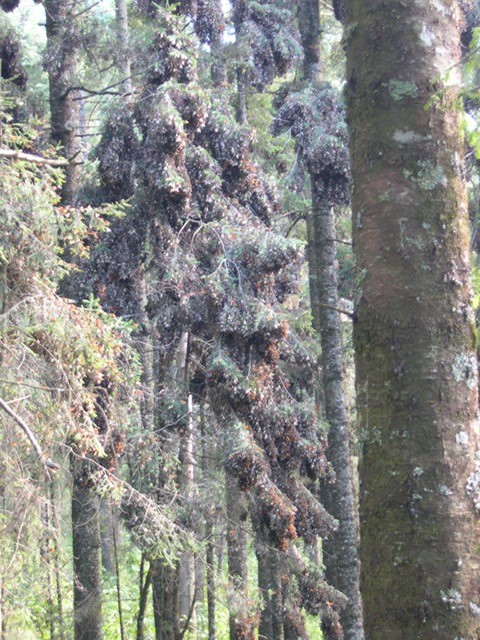
Tree branches droop with the weight of millions of monarch butterflies, wings closed, in huge clusters of tightly packed formations. Their brown masses well camouflaged, resembling parts of the oyamel fir and pine forests in which they overwinter in Mexico.
Photo credit here and above: Alan and Marie Roberts, Whitby
Back home, Marie and Alan started planting swan plants (milkweed) for the local monarch population which is also declining. The swan plant is the only thing the caterpillars eat. “We’re not gardeners by any stretch of the imagination” laughs Marie but a let’s see what happens approach and letting the plants self-seed led to a thriving patch of plants and hundreds of caterpillars and butterflies. “We had so many plants at one stage that we put out a call to the local school and Alan dug up bagfuls of plants for mums that turned up.” At the rate that caterpillars strip the leaves you need “lots and lots of plants” adds Marie, otherwise the caterpillars go off looking elsewhere and die. I recall my own dismal effort last summer with denuded swan plants, watching helplessly as caterpillars marched away up the driveway, never to be seen again.
Scattering packets of wildflower seeds on their property to see what pops up for the bees is something Alan and Marie also like to do. Last summer they had many bees visiting the purple and blue flowers, so this year they are going to double the size of the patch to keep feeding the pollinators. They are also lucky to have seen native bees living at their place! At first, they noticed small and slender black creatures burrowing into the sloping bank of their back yard and the sand between their patio pavers. They called over their neighbour who knew about insects (what a gem to have as a neighbour!) and confirmed that they were native bees. These bees are important to the survival of our flowering plants, particularly natives, and pollinate fruit and vegetable crops. There are 28 species, and most are found only in New Zealand. They don’t make honey or live in hives, but nest in the ground. It makes me wonder how many of us might have native bees in our gardens, but we don’t notice them. * I’ve put a link to great pics of native bees below.
I ask Marie and Alan why they do what they do for the pollinators. “I feel very protective of them because once they are gone, they are gone” says Marie. “Bees pollinate a third of the world’s food so if they go, humans haven’t got long. We only do our little bit as best we can and just hope that others may do the same, it all helps” They both look out for the birds too. “We have fantails and there is a little ruru that calls at night and either it or its descendants have been here since we came back from overseas eight years ago”
Alan and Marie have both worked professionally in the Middle East region, where making community ties and connections was vital. It’s something they continue in their Whitby neighbourhood where they share homemade cake and home-grown rhubarb with neighbours, give away plant seedlings, babysit the dog next door, and Alan volunteers for the pest free Whitby group and supported the local Emergency Response team.
I’m affected by the natural interlacing of their attentive and thoughtful reach out to the human and more-than-human community in the place where they all live.
* Interactive maps and information about the monarch migration courtesy of Monarch Joint Venture
* NZ native bee photos courtesy of the Phil Bendle collection, Citizen Science Hub
 Edge of Things
A story to spread far and wide…so wonderful to be reminded of the butterfly migration and its vastness.
What an excellent contribution to the local ‘hood these folks are making. Heart-warming !!
LikeLiked by 1 person
[…] look anything like honeybees and love to drill into the clay banks to make simple nests. They also popped up in Marie and Alan’s garden. * I’ve added a link below to a great blog about our native […]
LikeLike