
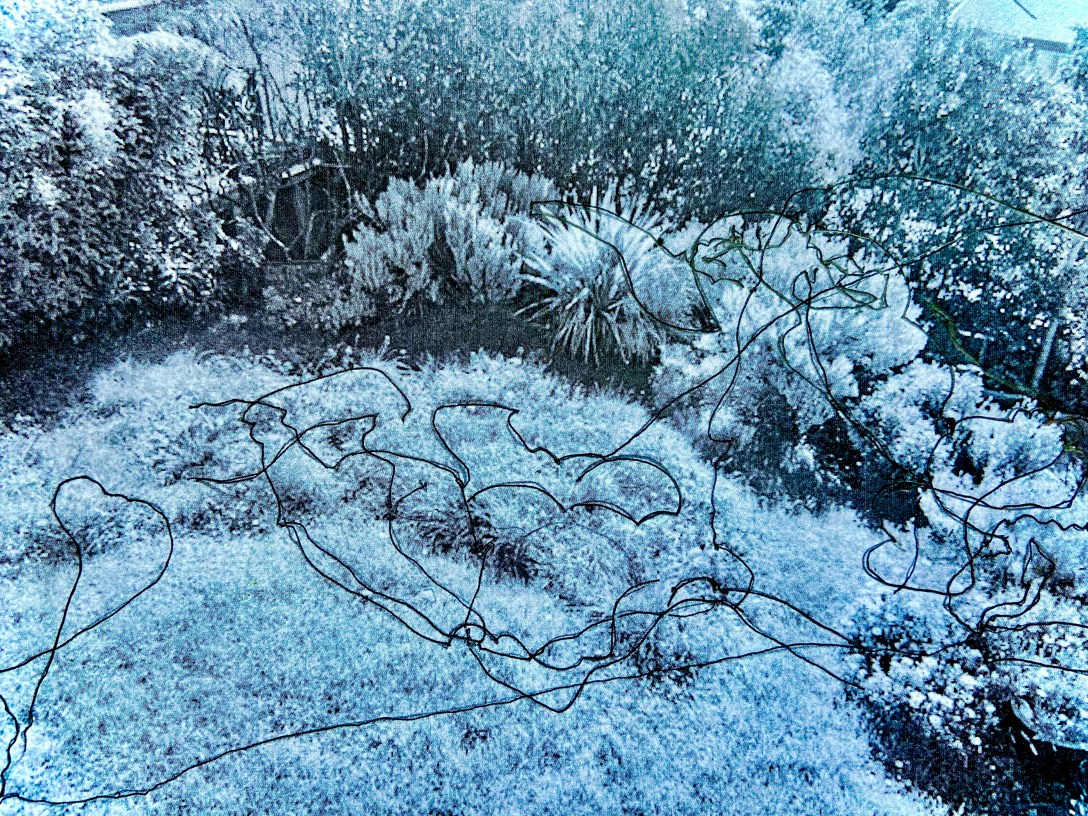
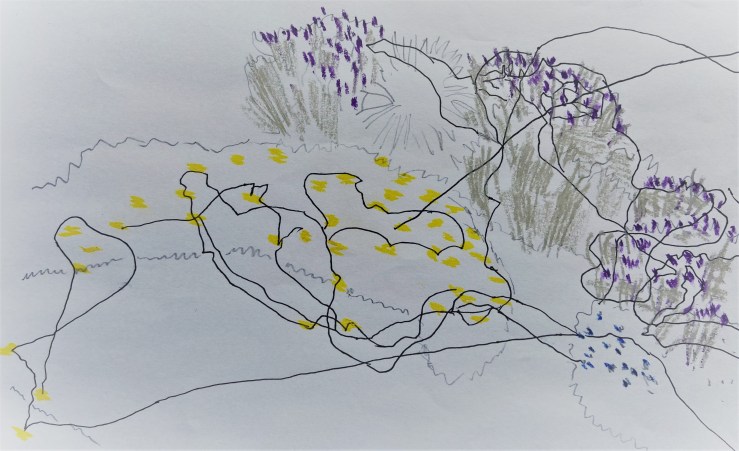
Still stuck at home with the flu, with little energy to much neighbourhood walking, Instead I get curious about the vitality of insects, and attempt to map their kinetic energy and pollinating pathways, during moments of warmth and sun following days of grey skies and rain. For half an hour I make line drawings, trying not to look at the paper, letting my eye and hand follow the paths of bees and flies as they fly in and out of frame, feeding on flowers.
There’s a distinction between the energetic smooth arcs of drone flies eating from a patch of wild dandelions (centre of image) and honeybees foraging on lavender flowers (upper right) making more concentrated, vertical and rotational movements over each flower. At face value it’s a random scribble. But watching closely their paths appear deliberate, orientating with a meaningful pattern and logic, not perceptible to me.
Radio NZ aired a story the other day about how commonly used pesticides are affecting the navigation abilities of insect pollinators. As a bee flies it is constantly gathering information to locate itself in relation to landmarks and light, using what’s called an optomotor response. A study looked at several groups of walking bees, feeding some a plain sugary solution and others a sugary solution contaminated with systemic insecticides (Sulfloxaflor and Imidacloprid, both commonly used in NZ). The bees who ate the plain sugary solution were fine but the bees who ate the contaminated sugar couldn’t reorientate themselves and took weird paths. Scientists believe the toxin damages the neurons in the bees’ optomotor response. What happens when kinetic patterns of insects are disrupted? What about the impacts to plants, humans and others if bees and other insect pollinators can’t forage or pollinate? The EU has a near total ban on some of these pesticides, but they are still used in NZ.
Bees exposed to pesticides show impaired visually guided behaviour
 Edge of Things
I’m curious, Nik, about how you did this…
Were you drawing on a photograph of your back garden? Or did you overlay the drawing later on the photograph? It sounds as though you were watching and drawing each individual flight path….
The information about pesticides is so sad. We’ve known since Rachel Carson laid it out in 1962 that pesticides kill lifeforms. But the profit motive triumphed.
Sorry you’re still at home with flu….
That was a lovely innovation for your project
I’m sure those bees and moths are aware of your loving attention, darl xxx
LikeLike
Thanks for your thoughts Fey. I experimented with different approaches and ended up line drawing (following individual bee flightpaths) on a greyscale photo. Not sure if it has captured the thought/feeling/moment I was after, but I’m now more curious about our interconnected energy paths.
LikeLike
I’m not up with the technology…great that you’re experimenting with new tools !xx
LikeLike