

I might be going balmy trying to rescue moths that have fluttered in through the kitchen door at night. It seems rather futile in the challenging swirl of the times – wars, pollution, deep fakes. What does it matter? But moths make me interested in the idea of navigation, of finding a way through. They are mostly nocturnal and orient themselves by the moon and stars. Our city lights confuse and startle this ancient ability to chart a course, and so the fragile beings batter away their short lives at our windows and streetlights that shine into the darkness – false beacons. Some of our ancestors shared that same ability to navigate using celestial bodies, and some people still do. Others quest even further beyond moon and stars for direction and meaning. Are we all somehow drawn together through space, searching for a pathway beyond the incomprehensible?
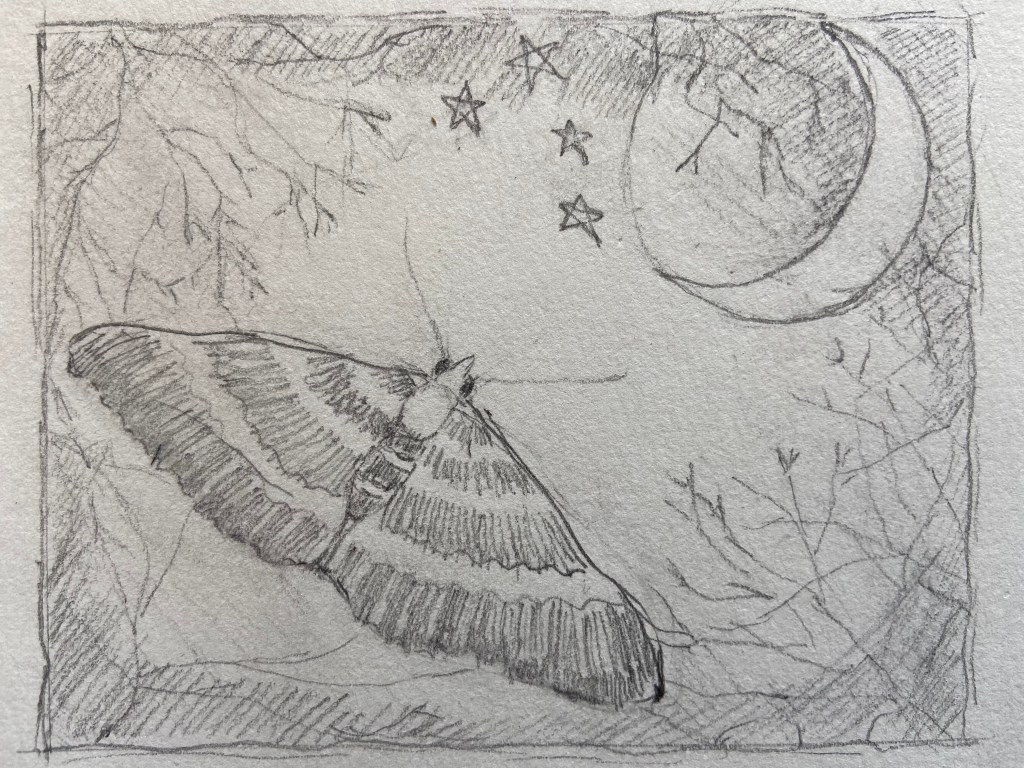
For the pūriri moth, one of our largest native moths, wayfinding through the moon and stars is literally a matter of life or death. After living five to seven years as a grub in a tree trunk, the adult moth emerges from its tunnel a night with just a few days to live. It has no mouth, and its sole purpose is to find a mate and reproduce. So, if shiny urban lights are suddenly attracting and distracting it from that goal of species survival, its long quest leads to an abrupt and barren end.


I love your sketch !
I’m pondering on the fact that the puriri’s life is so long as a grub and so short as an adult moth. They must be doing lots of interesting stuff as grubs….
Yes, such a shame that all our artificial lighting disorients them and stops them meeting mates
LikeLiked by 1 person
Thanks for your thoughts. I love that pondering too! The pūriri grub story gets even more complex. Morgane Merien says that when the caterpillar hatches out of the egg, laid on the forest floor, it has two feeding stages. In the first stage of its life it feeds on fungus of the leaf litter, then it moves off to feed on its host tree the pūriri. The moth is a beautiful sight, and yet there is such depth beneath the tip of what we see.
LikeLike
cool….
LikeLike