

It’s Aotearoa Moth Week! Science communicator, Morgane Merien says moths or pūrerehua are incredibly important. We have over 1800 species of moths in New Zealand, with around 90% of them being unique to here. They get a “bad rap” but are wonderful pollinators – second only to bees, an important food source for birds, and indicators of healthy environments (like a canary in a coal mine). Yet, relatively little is known about them and whether they too are declining like many insects.
What’s mostly worrying entomologists, says Merien is “the idea of insects declining or even going extinct that we don’t know even exist in the first place.” Merien is the NZ coordinator for national moth week, under the umbrella of the worldwide Moth Week (23 – 31 July). While winter is not the best time to observe moths here, it’s a great opportunity to learn about and document moths where we live. You can follow the project and post up images on inaturalist. The New Zealand Entomological Society is putting daily posts on social media, and I’m looking forward to sharing more of the fascinating conversation I had with Morgane in another blog.
I have a new-found appreciation for moths, particularly after a recent encounter with a bag moth. I had no idea we had such amazing beings right under our noses! In late April I came across a large cigar-shaped leaf near the gutter at the base of the garage door. It looked to be a cocoon of some sort that had fallen from overhanging trees in the high winds. Naively I thought it might be clever to observe it and see what might emerge. Many years ago, our seven-year-old had done the same with a windfallen branch of eucalypt that had a nut-shaped lump on it. Over time it was forgotten in the growing pile of shells, leaves, stones and other ‘nature finds’ that collected on the top of her desk. Then one morning, clearing the room, I came face to face with a striking, huge and furry gum emperor moth resting calmly at the edge of the desk.
This time I put my cigar-shaped cocoon in a shallow glass cup with the thickest part facing upwards (as I imagined it might hang from a tree) and placed it on my study bookshelf. The next morning, when I walked into the bathroom, the cigar was on the floor by the shower door. How had it got there? Perhaps a small mouse, which sometimes lurks under the bath, had dragged it there in the hope of a snack. There was a slight suction sensation as I picked it up. Not knowing what to do next I put it back outside, on the deck, hoping to observe from there. The following day it disappeared again. Confused, I thought that this time a bird had snatched it. But, on a longer look round, two metres below the deck, there it was, under a tarpaulin by the wood pile, close to where I had first found it! The runaway cigar thing had now got ‘him in-the-shed’ curious. We jumped online looking for ‘cocoons that move’ and discovered we had come across a common bag moth Liothula omnivora, which is endemic to New Zealand. It has an extraordinary life.

As a caterpillar, this moth creates a bag around itself, made of silk and leaf litter, which it drags behind it like a sleeping bag as it feeds on plants at night. When the caterpillar is frightened, as it must have with me, it retreats into its bag and draws the bag mouth closed. So, in the dead of night my caterpillar had somehow carefully got itself out from the cup on the bookshelf, crawled down, or perhaps let itself down by a silken thread, and inched across the floor to the bathroom. After I’d interrupted it and placed it on the deck it had done the same thing, getting itself down to the wood pile. I waited with much excitement and went out with a torch at 7pm. Sure enough, like something out of science fiction, the speckled head of the caterpillar had emerged, edging along the concrete on its front pairs of legs, and its bottom half in the bag being hauled behind. It could easily get trodden on so I moved it to a safe place in the garden. By midnight it had crawled a metre in the other direction, heading back under the deck. I vowed there would be no more interventions from me. How easily I had shamefully blamed a mouse or a bird for its removal.
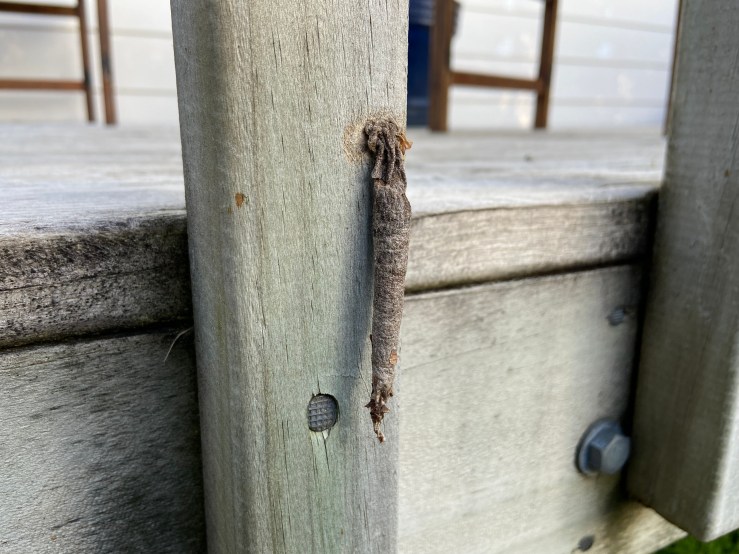
Oddly enough we were out on the deck yesterday and spotted a very similar bag attached to the bottom of one of the railings. This time the top of the bag is firmly closed and welded to the wood with thick silky binding. Could this be the same individual, months later? When they are ready to pupate, the caterpillars apparently secure themselves to a branch or other surface with more silk and tie off both ends of the bag. After hatching, the males moths fly off, but females never leave their bags – they have no wings, just an abdomen and a basic head. The males fertilise the female in the bag and after she lays the eggs, she dies. The tiny caterpillars leave the bag to start their own adventure.


Seen one of these before but didn’t know what it was! I will keep an eye out for them now
LikeLiked by 1 person
Thanks for reading! Yeah, I know what you mean about seeing these and not knowing what they are. I came across several of these cocoons in broom plants too around Whitby, but I’m not sure if they are just the remnant shells with the moths having left, or if they are pupating.
LikeLike
These are SO familiar from my childhood in the 1950s. The bags are exquisitely made and I was very curious then about what/who was inside. However, I never saw an occupant until now watching your footage. Knowing that the females have no life as separate beings outside their bag seems sad to me as a female human but Nature has her own ways. What would a she-moth say to me if I could ask her about her life??
LikeLiked by 1 person
Thanks for your comments Fey. How cool that the bag moths bring back childhood memories. Young eyes seem to zoom in better to the everyday details of life that often go unnoticed. I’m amazed to learn through Andrew Crowe’s ‘Which New Zealand Insect’ that we have over 50 species of bag moth in NZ and most are unique to here. A particular characteristic of these moths is flightlessness, and it’s usually the female. Yes, I’d love to know what a she-moth might say too! And how would she say it- through scent, or maybe sound waves?
LikeLike
Wow – fifty species of moths who weave bags !
I bow to the wonder and mystery of that…
LikeLiked by 1 person
[…] wrote about them in this earlier blog Night of the Bagmoth. They are unique to Aotearoa and one of over 1800 species of New Zealand moths, which science knows […]
LikeLike