The weather has turned. A low-pressure bomb travelled up from Antarctica and into the Tasman Sea, lashing thunder, rain, hail and tornadoes onto our coast.
Walking down to Pauatahanui Inlet, my nose and eyes stream in the wind, tips of fingers icy. I notice a white-faced heron, hunched in ruffled grey coat, observing the brown waters that race into the inlet from Whitby’s streams and drains-turned-torrents, flipping storm water lids. Seagulls turn steeply, their undersides flashing white under pink clouds. The sound of traffic as evening commuters head home to warmth, children and dinners. A driver yawns. Back up at Postgate Park a huge gum tree has crashed down, perhaps overnight. Its remains lie in butchered lumps and splinters, after someone has been in with a chainsaw. Old yellow toadstools lie in the grass nearby, rotting like sloughed skin. On the news I hear that hundreds of kororā/little blue penguins have washed ashore up North at Ninety Mile Beach. A DOC spokesperson believes they are starving to death as climate change is creating waters too hot for the fish they feed on.
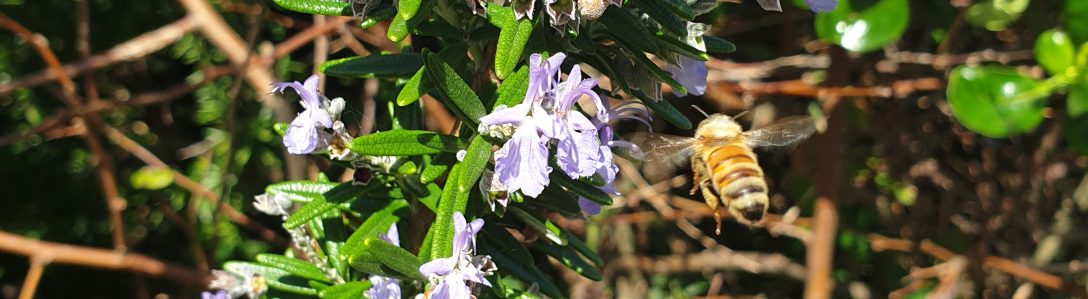
The day before the storm, at dusk, a solitary, large bumblebee methodically investigated all the cracks in our untidy rock wall. This was most likely a fertilised queen looking for a place to shelter during cold snaps until spring. The queens are the only bumblebees to survive during winter. Smaller workers and drones have already died by autumn.
I followed her movements, mostly by sound, under the darkening sky. For more than half an hour she hovered this way and that, crawling in and out of the cracks, and alternating this with flying into and around a tangled patch of old whekī tree fern and toetoe. She would stop periodically for 30 seconds and then was lost to me until she started buzzing again. Then she flew to a nearby Australian rosemary bush and up high I could just make out the small white flowers into which she was quickly dipping, before circling back to the search of the wall. After a while I became cold and I couldn’t hear her. I skulked back into the warmth and light of the house. What a being of incredible energy and determination, that bee. How hard she was working in that fading light.
I’m reminded of a phrase by anthropologist and author Anna Tsing who speaks of witnessing “wonder in the midst of dread.” Global catastrophes loom, but there was simple beauty in watching that queen.
For some reason my journey has started in winter. It’s not great timing as some of the most visible insect pollinators like bees and butterflies have either come the end of their lifecycles or are overwintering in sheltered places, only coming out when the air temperature climbs. It feels like much of life’s sap has returned to the roots, not just for trees, girding itself for the next season. The sun is low on the horizon, days are short, mornings and evenings are dark. The darkness mirrors my unknowing of all things insect. Perhaps this is apt. We’ve just celebrated Matariki, the Māori New Year, a time to gather with others to reflect back and forward.

 Edge of Things
Really interested to learn that just the bumble bee Queens make it through winter, and the drones die off. I’ve noticed a few around when the rain stops, finding what food they can. Good idea to give them sugar water. I think of them as part of the family!
LikeLiked by 1 person
Wow, what a cool idea to have bees as your family! It’s interesting that the human/bee relationship goes back many centuries and is enshrined in myths and legends across cultures. I was amazed to learn that bees are such ancient creatures, appearing roughly 130 million years ago soon after the first flowers appeared. I wonder about our NZ native bees/ngaro huruhuru which have evolved to pollinate Aotearoa’s native plants, but like our moths it seems there is relatively little known about them. I’m very keen to see one!
LikeLike