How to figure my way into 2024 in world that seems ever more uninhabitable? 2023 was the hottest year ever. Headlines scream this year will be worse. Devastating floods and fires are likely to repeat. Wars rage unchecked. At the same time my mailbox reminds me of work deadlines. I’m paralyzed by the discord of this – “there is a lonely absurdity in the idea of racing against the clock at the end of time” writes Jenny Odell in Saving Time: Discovering a life beyond the clock.
Continue reading “Champion for the Unloved”Category: Summer
Monarch dance
Earlier this year I watched as one of the first monarch butterflies circled the milkweed/swan plant below our deck. This time I grabbed a pencil and traced her flow on paper, intrigued at her mysterious path of many careful circuits. The drawing ends up a puzzling maze, as if meant to confuse. My notes read she spends minutes circling and making approaches to the plant, swooping past pumpkins, the mustard seed, the raspberries, the snowball tree, diverting attention? Perhaps checking it’s safe, scenting? It’s a dizzying energetic dance, never still. I trace the lines over and over trying to follow the complicated passage.
Continue reading “Monarch dance”First fruits
Picking ripening apples and plums on garden trees, foraging for blackberries in gullies, watching swelling pumpkins and birds eating karaka and karamu berries. Today I’m acknowledging all the unpaid work of our pollinator neighbours which now bears juicy fruit under the midsummer heat. Food for all of us – humans and more-than-humans.
Artist, writer and psychotherapist Juliet Batten’s calls this time ‘First Fruits’ – Te Waru (Māori) Lugnasad (Celtic) Lammas (Christian). It celebrates early harvest time and is one of eight seasonal markers based on pre-Christian nature-based festivals, brought into rhythm with Aotearoa’s southern seasons and into a relationship with practices and knowledge of Te Ao Māori.
Crimson language
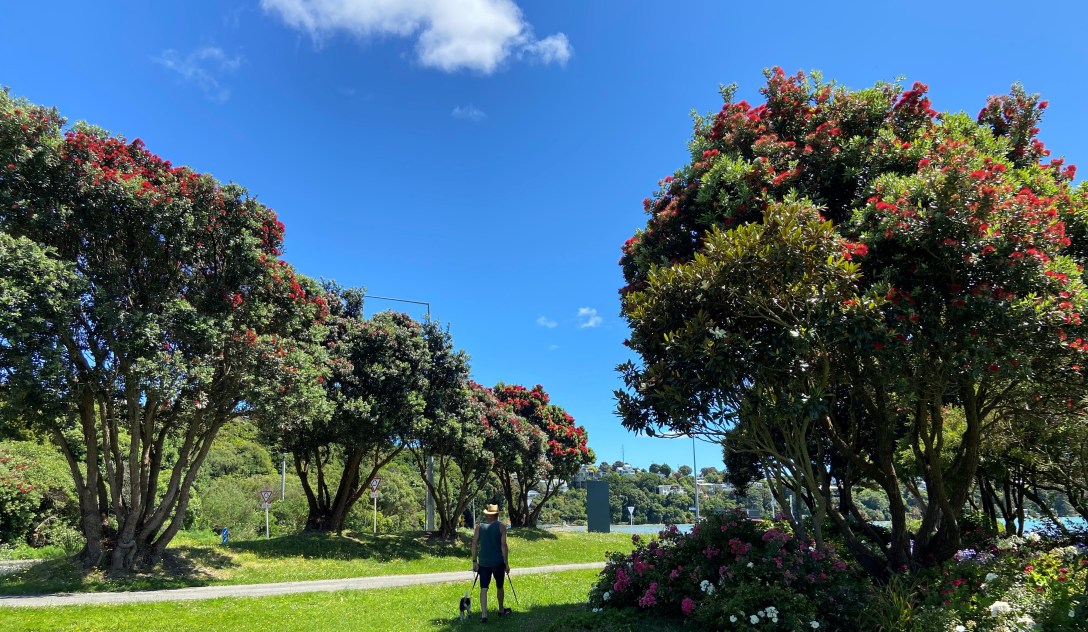
Like life blood through veins, pohutukawa blossoms course through the neighbourhood streets. It’s an intriguing pattern that pulses from tree to tree, as if by relay. First some, followed by others. Could there be something more than geography and climate that’s influencing this pattern? The trees in this community are close and experience the same weather.
Mike, a local, from Harris Road Honey, once told me that when the pohutukawa flower the honeybees will eat little else. I notice that as each tree blossoms the frenzied bees move in, undertaking what looks like an exhaustive pollination/eating session. How does the alliance and kinship language transmit between tree and pollinators to maximise their relationship? Perhaps by staggering their flowering, the trees share the attention of the local pollinators rather than scattering the bees’ focus across all trees at the same time. Potentially it creates a more comprehensive pollination for each pohutukawa and lengthens the their pollination/food period. A win win for tree and bee.
Continue reading “Crimson language”Pinpoints of energy
I’m underneath a large pohutukawa, my shoulder blades resting in earth, looking up at the fiery ring of blossoms etched out by sky and sun.
Light catches translucent wings of tens of hundreds of bees, and other flying insects attracted to the blaze. Pinpoints of energy, life patterning through air.
I’m stuck on the ground.
Feet sense
Tim and I stopped at the shore of Browns Bay by the inlet and watched schools of mullet bubbling and swirling beneath the glinting surface.
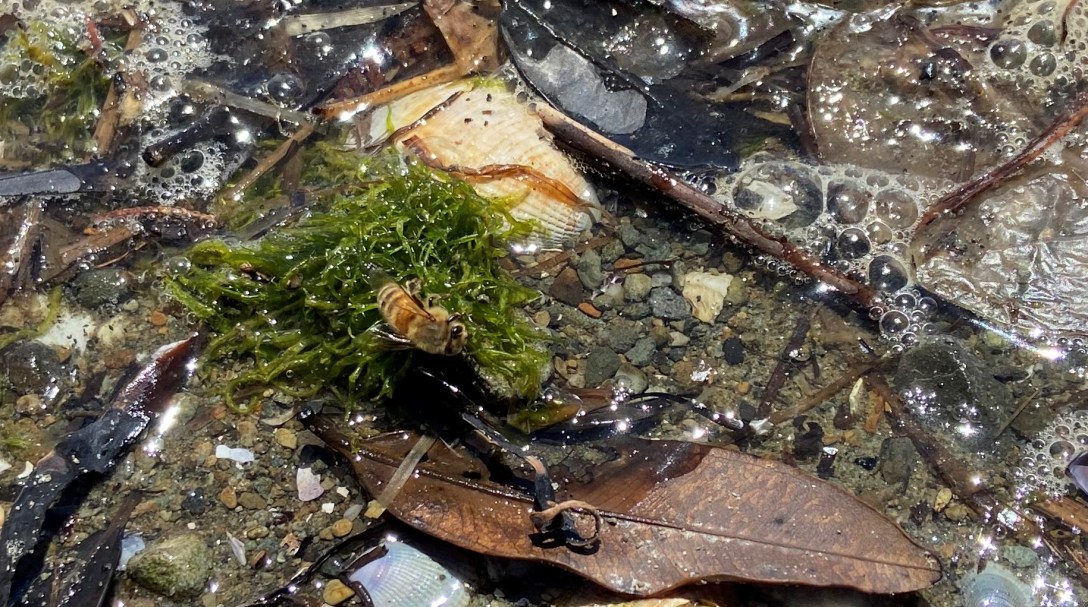
By the water’s edge I watched several honeybees hovering over the sand close to my feet. They were landing on small clumps of wet, green seaweed and walking over it – and tasting it! They weren’t interested in the dry seaweed, only the stuff being lapped by the small waves. What would the seaweed be providing them? Perhaps they were thirsty. I was so intrigued that I hoped online and read that honeybees have salt-sensing feet! They prefer slightly salted water and dirty water, which provide additional minerals and vitamins needed for their metabolism. Some honey producers feed seaweed to their bee colonies during lean times and in an effort to counter bee diseases and colony collapses.
Stephanie Pappas, a contributing writer for Live Science, writes about the bees’ salt sensing feet
Arrivals
New neighbours moved in a few weeks back. No one said anything but a couple of families set up camp in our front yard. I say ‘our yard’ but I’m not convinced it is. A piece of paper suggests we technically own the property, but does anyone really ‘own’ parts of Earth? Who was here before me, us – settlers, early Māori, more than humans? The recent arrivals seem to have a keener sense of ownership and purpose than me. One family is numerous, busy and bossy. They zig zag around me, in an irritated fashion, on their way in and out of the property. The other lot are more discreet, and quieter, occupying the far end of the courtyard.
Continue reading “Arrivals”