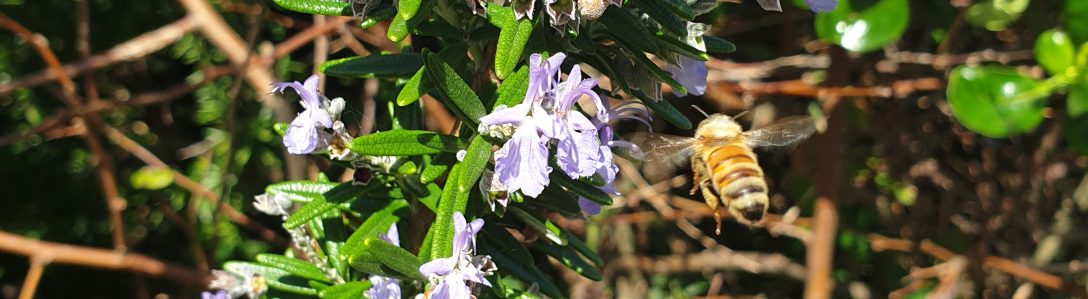
Welcome to this experimental journey where I’m attempting to pay closer attention to everyday encounters with pollinator insects like bees, butterflies, and moths in the places we live. Insects are declining drastically across the planet, yet they are vital to all life. I’m curious about who survives in my neighbourhood, how we relate with them, or they with us. So, I’ve committed to a walking routine along various street verges, tracks, unused plots, and small parks in the Porirua suburb of Whitby, plus my own tiny backyard, to journal, photograph and video day-to-day moments with these more=than-human beings. I’m also seeking to connect with my neighbours, locals, and others to gather and share stories of encounters with the insects.
Why am I doing this?
I’m a journalist, communicator and artist and this blog is part of a research project with Victoria University of Wellington. Like so many others during our COVID lockdowns, I noticed that when the human buzz subsided, we had space to notice little things in backyards and on local walks. We heard uncommon trills, chimes, and warbles across valleys and city streets. Bees hummed around wildflowers popping up in less manicured and neglected verges. When humans retreated, it seemed there was an opening for other beings to re-flourish. I’m hoping to creatively explore these relationships further, particularly with insects who often go unnoticed.
Why insect pollinators?
Insects are ancient creatures from beyond human timescales. While they’re all around us it’s only recently that stories about their drastic decline across the planet have hit the headlines. And while people are now waking up to the plight of their honeybees who’ve sharply dwindled since 1990, the circumstances of Aotearoa New Zealand’s own native pollinators are largely unknown, like native bees (ngaro huruhuru), moths, butterflies, and beetles which have evolved to pollinate the country’s native plants, which in turn support a range of species. We are only just beginning to understand what the loss of insect pollinators might mean, including more lifeless landscapes, broken food webs and less food for living creatures, including us. The reasons for the insect decline are hard to untangle but loss of habitat, climate change, widespread use of chemicals and light pollution seem to be the key ones. As our growing populations and cities occupy more rural land and our residential neighbourhoods and suburbs become more common habitat areas, I wonder what happens to these insect pollinators?
The beginning
It feels like I’m about to go down Alice’s rabbit hole (or maybe that should be down a bumblebee nest). I have no idea what to expect from the journey. It could be rather weird or even nonsensical at times. A snatch of Alice’s conversation with the gnat in Lewis Carroll’s Through the Looking-Glass comes to mind. It’s bizarre but also perhaps a little revealing around the plight of insects.
“‘Crawling at your feet,’ said the Gnat (Alice drew her feet back in some alarm), ‘you may observe a Bread-and-Butterfly. Its wings are thin slices of Bread-and-butter, its body is a crust, and its head is a lump of sugar.’
‘And what does it live on?’
‘Weak tea with cream in it.’
A new difficulty came into Alice’s head. ‘Supposing it couldn’t find any?’ she suggested.
‘Then it would die, of course.’
‘But that must happen very often,’ Alice remarked thoughtfully.
‘It always happens,’ said the Gnat.”
Your stories
This journey is an experiment for me, and I’d love to hear about your experiences too. Please feel free to leave a comment with anything from random thoughts, experiences, thrills, fears, corrections, or debates. You can also email me at nikki.wright@vuw.ac.nz
The blog is arranged so that the latest entries appear at the top of the home page. But if you prefer to read the journey from the start, click on the ‘next post’ at the bottom of this page.
 Edge of Things
Love this blog. Takes me back to the magic of Thoreau’s Walden Pond where he spent a whole year in the same place recording all the amazing plants & critters he encountered every day. Do you use binoculars? It’s amazing to zoom in close-up on our bees, moths etc.
LikeLiked by 1 person
Thanks Pam – Great to hear about Thoreau’s Walden. It sounds interesting. With the whole business of slowing down and noticing, I’m finding myself fascinated with the concept of whole ‘worlds’ contained within just a few metres of lawn, or bush, or the side of a road.
LikeLike
I was inspired by this piece from Charles Eisenstein about the sense of wonder a monarch butterfly evoked in him – the only one has has seen all summer. Lots of synergies with your lovely Edge of Things blog. Have a read:
https://mail.google.com/mail/u/0/?tab=rm&ogbl#search/charles/FMfcgzGpHHTQwtZsMpBgvXbwTDzvFcQb
LikeLiked by 1 person
What a beautiful intro to you research Nikki! Love the Lewis Carroll reference -made me a little sad. Looking forward to following your journey!
LikeLiked by 1 person
Thanks for reading and following Carolyn! Yes, really agree with you regarding the Lewis Carroll writing. Something compelling about hearing things from the voice of a gnat. Makes me think about the world a little differently too.
LikeLike