

How to figure my way into 2024 in world that seems ever more uninhabitable? 2023 was the hottest year ever. Headlines scream this year will be worse. Devastating floods and fires are likely to repeat. Wars rage unchecked. At the same time my mailbox reminds me of work deadlines. I’m paralyzed by the discord of this – “there is a lonely absurdity in the idea of racing against the clock at the end of time” writes Jenny Odell in Saving Time: Discovering a life beyond the clock.
I try to focus on being ‘here and now’ and small stuff, where we can make a difference. It reminds me of a conversation I had with Dr Julia Kasper, a lead entomologist at Te Papa. She’s a champion for the microcosmos, the cryptic and largely unloved insects around us. The ones that make us gasp or reach for a can of spray. The ones we cannot live without.
Julia sparkles with directness, quick intellect, humour and quirky surprises when talking about anything from bees and fungus gnats to blowflies and carcasses. From the endearing to the disgusting! As a child she’d protect ants that other kids wanted to stamp on or torture. She would plunge into the pond she and her father built in their Berlin backyard and imagine “shrinking and diving into the pond together with the insect and dragonfly larvae.”

Children are often curious about insects, but that gets destroyed as we grow up she believes. We become obsessed with day-to-day actions and tasks. Plus we also live in more urban and sterile worlds. But Julia adds that we also have a “deep instinct for self-protection, a warning system because there may be venomous spiders and things that least resemble us in looks, like something that has eight legs, is hairy and has strange movements!”
Julia is intrigued by things that repel us, “I love gross stuff!” Her specialties are flies, how insects orientate by smell, medical entomology (think blood suckers and disease transmission) biosecurity and conservation. She’s also fascinated by human/insect folklore, and stories created about natural phenomena that people at the time couldn’t explain through science. [Her article about vampires and mosquitos is an interesting read – see below **] Why does she do this, I ask. “Insects are the underdogs, they are the unloved and flies are probably the worst. But I always want to help them and be their advocate because they are so amazing.”
She started her studies with dung beetles and moved onto blow flies. “The dung was nothing compared to the smell of the corpses!”, she laughs adding that blow flies are just survivors and are so helpful to us. “We find it disgusting, but they’re there and they help us, cleaning that up and turning it back into life, bringing nutrients back into the cycle.” It’s one of those helpful but invisible things that insects do.

These days Julia’s research focuses on the smaller flies – the gnats, mosquitos, midges, and craneflies which are the most diverse and widespread pollinators on earth. They are in every niche and ecosystem. “All those fragile long-legged fairy-like flies are so super, super important for the ecosystem in terms of forest health, pollination, the food chain. And their larvae are mostly aquatic so they are particle feeders and clean the waterways.” If we don’t conserve them, we’ll all be in trouble, she warns.
The crucial bit we forget is that pollination is not only about bees. It’s about flies, moths, beetles and also lizards, birds and bats, she emphasises. “We need all of them to have something to enter into all the niches of different plants because the pollinators have different mouth parts, they have adapted to different smells, to different colours.” Some, like moths pollinate at nighttime, others only in warmth and daylight. So, just concentrating on honeybees means they won’t service everything.
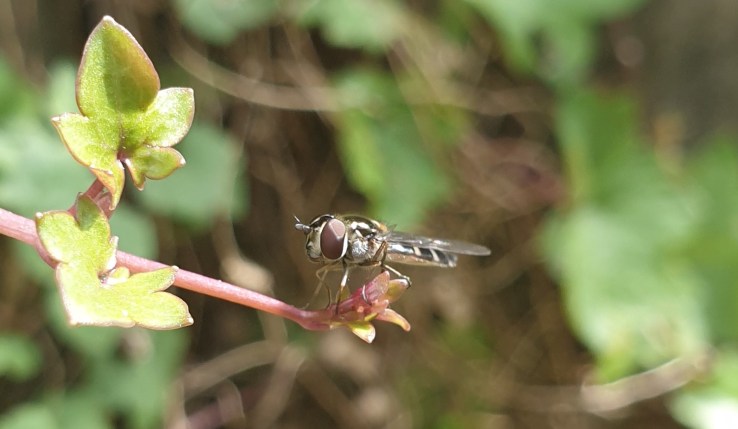
I’m curious about what’s happening with insect pollinators in cities and suburbs like ours in Whitby/ Pāuatahanui. “There is never enough knowledge, we lack lots of knowledge about the network. What we understand is only a few puzzle pieces but how they are connected we don’t know”, says Julia. Cities are already quite fragmented due to urban sprawl and infill housing but there are still pockets or islands of habitat that can be helpful for insect pollinators. Studies suggest some species are doing well in those pockets and parks, but others are not. And it’s not just about habitat loss. Pesticides and herbicides are known to cause harm to beneficial insects.
Julia thinks that the result of all this is that we will lose many species that are very specific and adapted to specific niches while others that are more generalists will survive. She illustrates this vulnerability with a poignant story about a gnat, a fungus and an orchid. A female fungus gnat is drawn to the scent of a fungus on which to lay her eggs and for the larvae to eat when they hatch. And a spider orchid can mimic the smell of this fungus. It attracts a female fungus gnat to it and when she lands on the orchid she inadvertently pollinates it while she lays her eggs. If we lose the fungus we lose the gnat, and if we lose the gnat, we lose the orchid – a very unique NZ plant. “Most people would say that they don’t care about that one fungus gnat and that one orchid, but it doesn’t stop there it goes on and on” says Julia. “It’s a network or a puzzle and if you lose pieces then the whole thing collapses like a house of cards.”
*Julia’s Te Papa blogs https://blog.tepapa.govt.nz/author/julia-kasper/
** Julia’s article on vampires and bloodsuckers https://jgeekstudies.org/2022/08/14/did-dracula-really-transmit-the-plague-the-history-of-bloodsuckers-and-their-diseases/
 Edge of Things